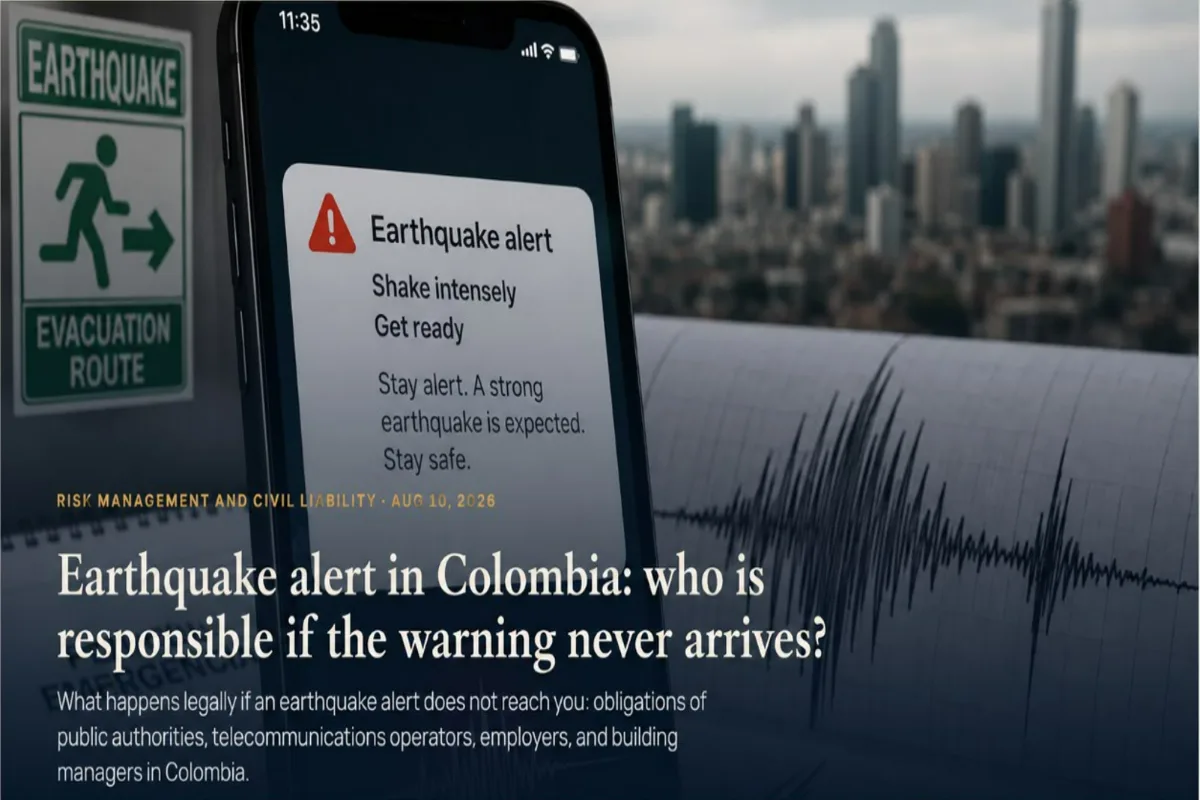
After an earthquake, something happens today that would hardly have been part of the conversation a few years ago: people compare their phones.
One person received a warning seconds before the shaking began. The person sitting next to them did not. Someone else saw the notification only after the movement had already started. Others discover, once the immediate concern has passed, that their phone had an earthquake-alert feature they did not even know existed.
The first questions are usually technological: which phone was it, which operating system did it use, was location enabled, and why did one device issue a warning while another remained silent?
There is, however, a different question behind all of this.
If a warning that could have alerted someone to an earthquake never arrived, does that mean someone breached a legal duty?
Not necessarily.
And that distinction matters.
An earthquake alert is no longer only a technological issue
For many years, the legal questions surrounding an earthquake began after the shaking: whether a building was safe, whether an evacuation plan worked, how public authorities responded, or whether an employer had adequately protected the people inside its premises.
Phones have introduced an earlier moment.
A person may now receive a warning before feeling the earthquake. It may provide only a few seconds, but in certain circumstances those seconds can be enough to move away from a falling object, interrupt a hazardous activity, or follow a safety procedure that has already been learned.
That changes the discussion.
It does not mean that every warning appearing on a phone has the same legal status.
A notification produced by a private system built into a mobile device does not become an official warning issued by Colombian authorities simply because it concerns an earthquake.
Before asking who is responsible for a failed warning, it is necessary to identify what, exactly, was supposed to work.
What does an "alert" mean under Colombian law?
Colombia's disaster-risk legislation used the concept of an alert long before smartphones began warning their users about earthquakes.
Law 1523 of 2012 — Ley 1523 de 2012 — treats an alert as something connected to the monitoring of a dangerous event and to the activation of previously established response procedures.
That last element is important.
A warning is not particularly useful merely because a message appears on a screen. It becomes useful when people know what to do with the information.
An office gains little from an earthquake notification if nobody knows the evacuation procedure. A factory gains little from an alarm if there is no safe way to stop hazardous equipment. A sophisticated warning system is of limited value in a building whose occupants have never been told how to respond.
Disaster-risk management is therefore broader than detecting danger.
It includes understanding risk, reducing it and preparing to respond when the event actually occurs.
Is an Android earthquake alert an official Colombian government alert?
This is where an easy misconception can arise.
Google operates an Android Earthquake Alerts System, and Colombia is among the countries where that system is available.
That does not automatically transform an Android notification into an alert issued by the Colombian government.
Different systems are involved.
Public authorities — including the Servicio Geológico Colombiano and the UNGRD — have their own responsibilities for disaster-risk monitoring, information and response. Telecommunications networks have roles during emergencies. Technology companies may also provide private services capable of detecting certain events and warning their users.
Those systems may complement one another.
They should not be treated as identical.
Google itself explains that not every earthquake can be detected, that magnitude and shaking estimates may contain errors, and that a warning may arrive before, during or after shaking begins.
The fact that two people standing in the same place had different experiences therefore does not, by itself, establish negligence.
The first step is to understand which system was operating and under what technical conditions.
Why did one phone receive a warning while another did not?
There may be several explanations.
Devices can have different settings. Features are not necessarily identical across operating systems. Connectivity may matter. Approximate location may matter. A service may operate differently depending on the region and on the technical criteria used to determine which devices should receive a warning.
Even Android acknowledges that not every earthquake will be detected and that users will not necessarily receive a useful warning before shaking begins.
That distinction is legally significant because a different outcome is not the same thing as proof of wrongdoing.
"My phone did not alert me, while someone else's did" describes a fact.
It does not yet establish liability.
That would require identifying who owed a particular duty, what that duty required, whether the person or entity was capable of performing it, and whether the duty was actually breached.
Can a failed warning create legal liability?
There may certainly be circumstances in which a failure related to an emergency has legal consequences.
But the absence of a notification does not automatically produce liability.
The analysis begins with a more basic question: who allegedly owed the duty that was breached?
A privately provided technology service is not the same as the conduct of a public authority responsible for disaster-risk management.
A telecommunications network is not the same as an employer's obligation to prepare for emergencies within its workplace.
Once the responsible actor has been identified, the next question is the nature of the duty itself.
Then come the difficult questions.
Was the duty actually breached?
Was there damage?
Would the damage probably have been avoided if the required conduct had occurred?
Is there a sufficiently direct causal relationship between the alleged failure and the harm?
The occurrence of a serious event does not eliminate the need to answer those questions.
Telecommunications operators belong to a different emergency framework
Telecommunications become particularly important during an emergency.
Colombian regulation, under Decree 1078 of 2015, provides for a National Emergency Telecommunications System and addresses communications among public authorities, between authorities and the population, and communications initiated by individuals during emergencies.
The reason is practical.
During a disaster, large numbers of people may simultaneously try to call, send messages or obtain information. At the same time, public authorities need communications to coordinate rescue operations, medical care, public safety and emergency response.
That framework should not be confused with a particular feature incorporated into a smartphone or operating system.
Different emergency-communication mechanisms may interact, but legally they are not necessarily the same service.
That distinction must be made before attributing responsibility to a mobile operator for a warning that may never have depended on that operator in the first place.
Employers cannot simply wait for a phone to sound
This may be one of the clearest legal consequences of the discussion.
An employer does not satisfy its emergency-preparedness duties by providing workers with smartphones and hoping that an application will tell them what to do.
Colombia's Occupational Health and Safety Management System, under Decree 1072 of 2015, requires considerably more.
Employers and contractors must identify threats that could affect their workplaces, assess vulnerability, evaluate risk and maintain measures for prevention, preparedness and emergency response.
There must be a plan.
And that plan must work even when every phone in the building remains silent.
Consider an ordinary office.
Do people know how to protect themselves while the shaking is occurring?
Do they know the evacuation route?
Is it clear when evacuation should take place?
Are people assigned to guide the response?
Have objects, installations or structures that may create additional hazards been identified?
Does the procedure account for visitors who do not know the building?
Those questions have little to do with the brand of a smartphone.
They have a great deal to do with duties that exist regardless of whether any device issues an alert. Companies that already run a proper occupational risk-management system tend to have this front covered; those that do not are exposed precisely when it matters most.
An employer cannot replace an emergency plan with the expectation that Google, Apple or another technology platform will warn its workers.
What if the problem was not the warning, but the building?
Earthquakes also tend to produce another immediate assumption: if a building was damaged, someone must have built it improperly.
That conclusion is equally unsafe.
Colombia has long had a specific seismic-resistant construction regime. Law 400 of 1997 — Ley 400 de 1997 — established requirements for the design, construction and technical supervision of buildings, including the objective of reducing the risk of loss of human life from seismic forces.
But "seismic resistant" does not mean "indestructible."
A building may sustain damage during a powerful earthquake without that fact alone proving that a legal or technical requirement was violated.
A proper investigation starts afterwards.
Which rules applied when the building was designed and constructed?
What did those rules require?
Was the building constructed according to the approved design?
Was it altered later?
Were there known maintenance or structural problems?
What type of damage occurred, and what caused it?
An earthquake may simply be the natural force that tests a properly designed structure.
It may also reveal a vulnerability that existed beforehand.
Distinguishing between those possibilities requires technical evidence, not intuition.
Damage does not, by itself, identify who is liable
This can be difficult to remember while the impact of a disaster is still fresh.
After a serious event, it is natural to look immediately for an explanation and often for someone responsible.
Law requires a more careful process.
A missing alert does not by itself prove an attributable failure.
An emergency in a workplace does not by itself establish that the employer breached its obligations.
Damage to a building does not automatically prove a violation of seismic-resistance standards.
But the opposite assumption is equally problematic: the fact that an event was caused by nature does not mean that nobody can ever be responsible.
Natural disasters do not erase legal duties that existed before the event occurred.
Public authorities may have duties.
Employers may have duties.
Designers, builders, supervisors, administrators and operators may have duties as well.
The legal task is to separate the natural event itself from the human decisions that increased, reduced or properly managed the risk.
The right question is not simply why the phone remained silent
Earthquake alerts on smartphones can create the impression that technology has taken over a task that once belonged to institutions, procedures and people.
It has not.
A warning of a few seconds may be extremely valuable.
It remains only one part of a much broader system of prevention and preparedness.
If an alert fails to arrive and harm later occurs, the legal question should therefore go beyond "why didn't my phone warn me?"
Which system was expected to provide the warning?
Who operated it?
What did it undertake to do, and under what conditions?
Was there a specific legal duty?
What did the relevant public authorities do?
What emergency procedures existed where the person was located?
Were the rules applicable to the activity or building followed?
And, most importantly, which of those circumstances actually contributed to the damage?
Those questions may ultimately establish liability.
They may also establish that there was none.
That difference is precisely what separates a legal analysis from a conclusion reached in the immediate aftermath of fear.
Before speaking of liability, one must identify the duty, who owed it, the breach, the harm and the causal link.
Every emergency has different technical and legal circumstances. When personal, property or business losses occur, assessing potential liability requires reconstructing the applicable duties, the conduct of each participant and the relationship between any alleged omission and the resulting harm.
Bonett Locarno Pumarejo Abogados approaches complex disputes through the evidence and the legal framework applicable to each individual matter.
Main sources: Law 1523 of 2012; Decree 1078 of 2015; Decree 1072 of 2015; Law 400 of 1997; Servicio Geológico Colombiano; UNGRD; Android Earthquake Alerts System, Google.